Risk Management
Basic Risk Management Policy
The MIRARTH HOLDINGS Group identifies and manages each risk in line with its basic risk management policy, which encompasses ensuring the safety of customers, partners, officers, employees, and their families; fulfilling its social responsibility; harmonizing with the global environment; maintaining sustainable business practices; and enhancing corporate value. In addition, the Risk Management Committee has been established as a structure to promote ensure thorough risk management throughout the Group.
Risk Management
Risk Management System
In order to support the stable and sustainable growth of the Group, MIRARTH HOLDINGS actively and strategically practice risk management by regularly convening the Risk Management Committee, which oversees risks across the entire Group.
In addition to holding four regular meetings annually, the Risk Management Committee is convened as needed in response to changes in the industry or market environment. Through this structure, prompt decision-making and appropriate responses to risks are ensured.
Chaired by the Group CRO, with the Group CFO and two outside directors serving as members, the Committee is structured to enable agile and expert evaluation and decision-making regarding risk. Furthermore, by including the head of the Legal Department in the Committee, the Company strengthens deliberation from a legal perspective and achieves more comprehensive risk management. With the Auditors participating as an observer, oversight and objectivity within the risk management process are also ensured.

Risks and Opportunities
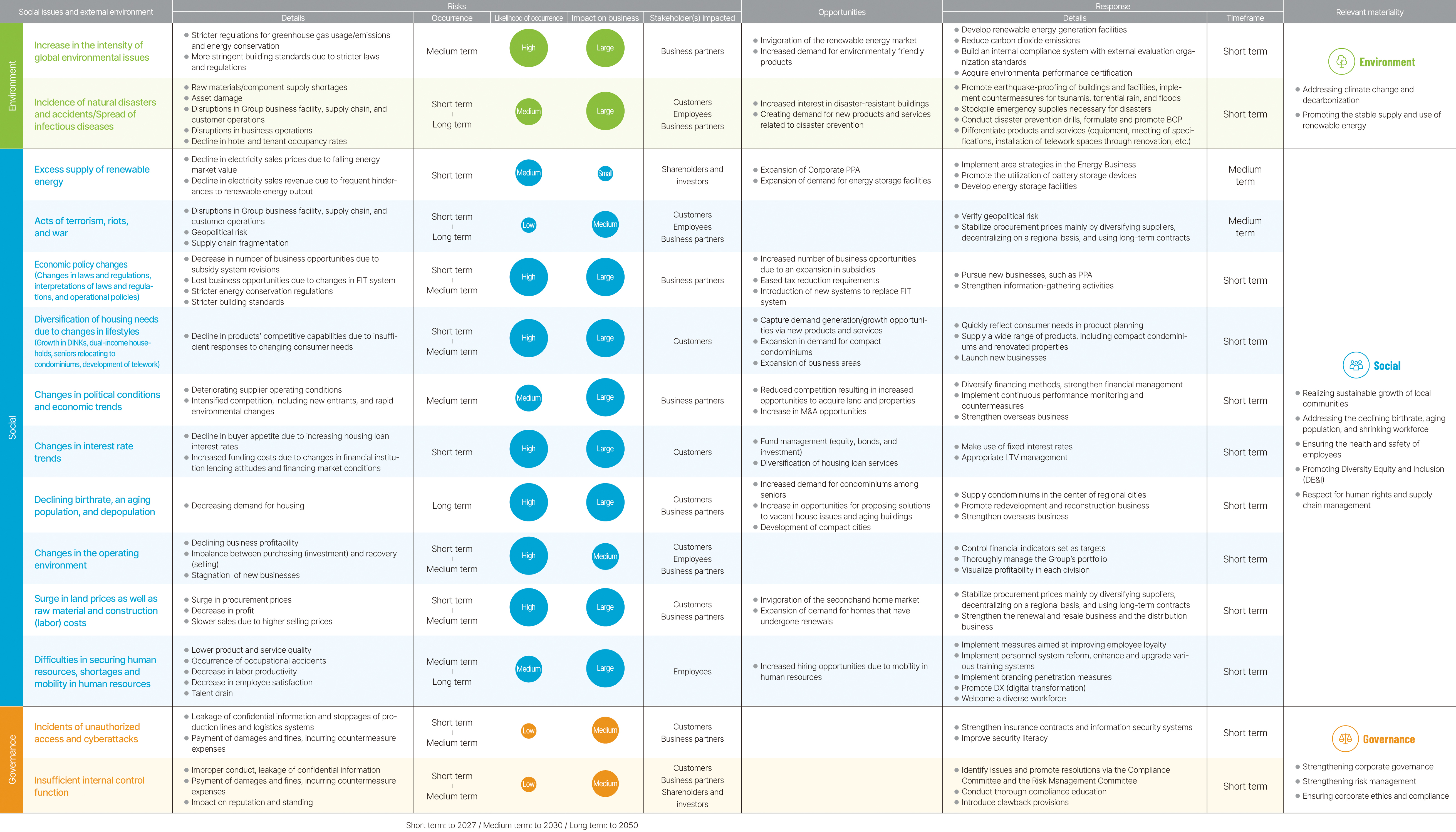
As risks that significantly impact business activities become increasingly diverse and complex on a daily basis, our Group predicts potential future events, identifies risks and opportunities, and utilizes this knowledge to address social issues and create value.
Strengthening BCP
Our company has established a group-wide information aggregation policy to ensure prompt and accurate information aggregation and decision-making in the event of major earthquakes or other large-scale natural disasters, infectious diseases, or man-made disasters (war, terrorism, accidents, etc.). When a major earthquake strikes, it is essential to gather accurate information quickly. It is necessary to make prompt decisions based on information such as the extent of the damage, the safety of employees, and the impact on business operations. We have established specific rules regarding reporting standards and information aggregation, and are working to ensure that all group companies are fully aware of these standards and rules to quickly establish a business continuity system.
Formulation of BCPs and Manuals, and Employee Training
Our company and Takara Leben have formulated a "BCP (Business Continuity Plan)" and a "Response Manual" to ensure the safety of employees and their families during large-scale disasters, while also preserving business assets and enabling early recovery and continuation of core businesses. Through these efforts, we clarify the roles and behavioral guidelines of the entire group and major companies.
In addition, training was conducted for all employees to deepen their understanding of the contents of the BCP and the Response Manual.
In the event of a major earthquake directly beneath the capital, we have developed a Manual for Responding to a Major Earthquake Directly Beneath the Tokyo Metropolitan Area that clearly outlines initial response procedures, given the potential for significant impact on our headquarters functions and core business operations. Furthermore, we conduct training sessions to ensure that this manual is widely understood and implemented, and to review basic knowledge of the BCP and emergency response systems.
Responding to Infectious Diseases
In the event of an infectious disease outbreak, the Group will promptly implement measures led by the Crisis Management Committee to protect the health and safety of employees, families, and customers while ensuring business continuity.
In the early stages of the COVID-19 pandemic, we established basic policies and response flows for handling confirmed cases, and thoroughly implemented a prompt reporting system, rules for returning to work, and disinfection procedures. In addition to introducing teleworking and flexible working hours, we flexibly reviewed rules for meetings and business operations in accordance with the infection situation.
Furthermore, at customer touchpoints such as model rooms, we implemented hygiene measures including mask-wearing, ventilation, disinfection, and testing. We also took steps to ensure the safety and well-being of our employees and their families, such as utilizing PCR testing, providing vaccination leave, and supporting self-isolation.
We will continue to respond flexibly and appropriately to the risk of infectious diseases and maintain a safe and secure environment.