Corporate Governance
Basic Approach
MIRARTH HOLDINGS Group has set "Our Purpose" as "To design sustainable environments for a happier future for both people and our planet," and recognizes that addressing issues related to sustainability is an important management issue. We will not only pursue profits, but also comply with laws, regulations, corporate ethics, fulfill our social responsibilities as a member of the corporate community, and aim to sustainably enhance our corporate value.
To this end, our basic approach to corporate governance is to always consider the happiness of all stakeholders, including customers, employees, business partners, local communities, and shareholders, and to promote sound corporate activities by making decisions quickly and responding flexibly to changes in the business environment, as well as ensuring thorough compliance and transparency in decision making.
Initiatives to Strengthen Corporate Governance
| Details of Initiatives | |
|---|---|
| 2010 | Introduction of executive officer system |
| 2012 | Introduction of stock-based compensation stock option plan for directors (excluding outside directors) and executive officers |
| 2016 | Start of evaluation of the effectiveness of the Board of Directors |
| 2017 | Term of office for directors changed from two years to one year |
| 2019 | Establishment of Nomination Committee and Remuneration Committee |
| 2020 | Appointment of outside directors as chairpersons of the Nomination Committee and Remuneration Committee |
| 2021 | Appointment of two female outside directors |
| Ratio of outside directors increased to one-third (4 outside directors out of 12 directors) | |
| Revision of executive remuneration system (introduction of non-financial indicators as evaluation items) | |
| 2022 | Disclosure of the skills matrix |
| Transition to a holding company structure |
Corporate Governance System
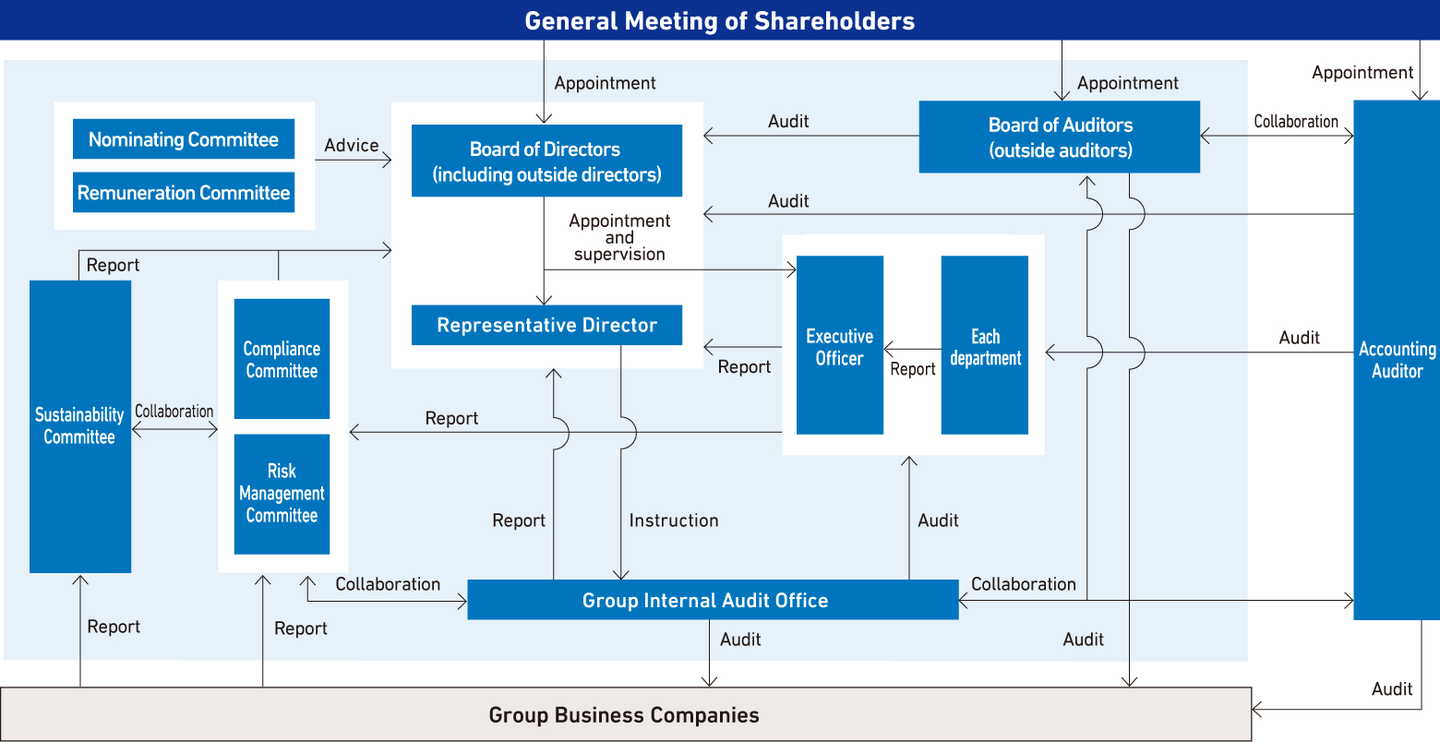
MIRARTH HOLDINGS has established a system to ensure the appropriateness of management through careful and prompt decision-making by the Board of Directors, appropriate supervision of business execution by directors, auditing and supervision of directors’ business execution by corporate auditors. In addition, the Company has adopted an executive officer system to clarify the management oversight responsibilities of directors and the business execution responsibilities of executive officers.
Corporate Governance System Trends
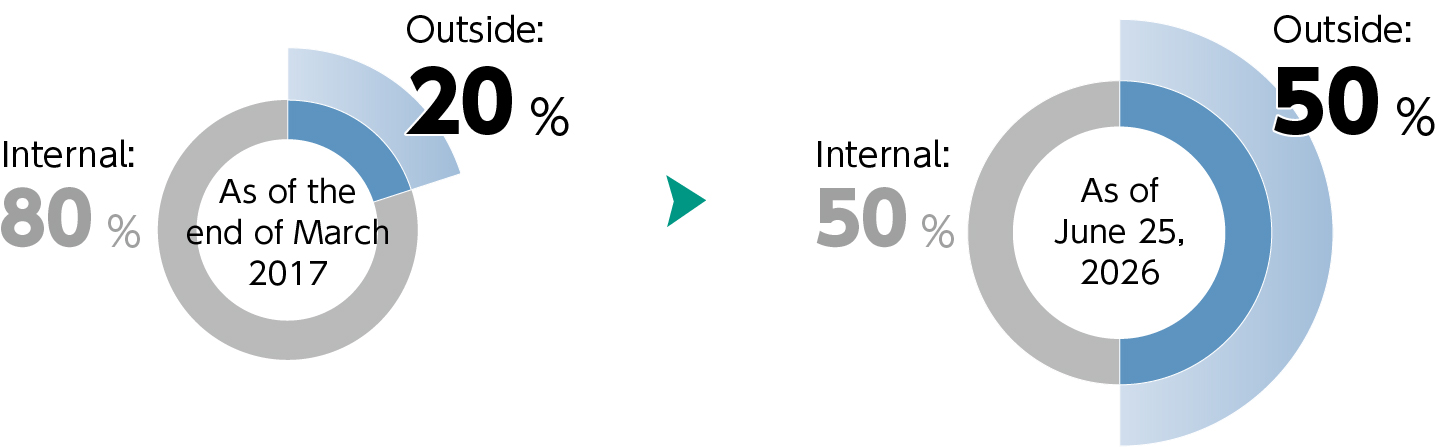
The Board of Directors consists of eight members, four of whom are independent outside directors with diverse backgrounds. Directors serve a term ending at the conclusion of the General Meeting of Shareholders for the final fiscal year ending within one year after their election. In FY2025, the Board of Directors convened 17 times.
The Board of Auditors consists of three members, all of whom are outside auditors, thereby establishing a framework that enables sufficient external oversight of management. The Board of Auditors shares issues and information among its members and, when necessary, requests information from directors and departments to enhance the quality of audits. In FY2025, the Board of Auditors convened 12 times.
| Fiscal Year | Form of Organization | Total Number of Directors | Number of Outside Directors |
Total Number of Auditors | Number of Outside Auditors |
|---|---|---|---|---|---|
| FY2016 | Company with Board of Auditors | 10 | 2 | 3 | 3 |
| FY2017 | Company with Board of Auditors | 10 | 3 | 3 | 3 |
| FY2018 | Company with Board of Auditors | 11 | 3 | 3 | 3 |
| FY2019 | Company with Board of Auditors | 13 | 3 | 3 | 3 |
| FY2020 | Company with Board of Auditors | 13 | 4 | 3 | 3 |
| FY2021 | Company with Board of Auditors | 12 | 4 | 3 | 3 |
| FY2022 | Company with Board of Auditors | 12 | 4 | 3 | 3 |
| FY2023 | Company with Board of Auditors | 6 | 4 | 3 | 3 |
| FY2024 | Company with Board of Auditors | 7 | 4 | 3 | 3 |
| FY2025 | Company with Board of Auditors | 7 | 4 | 3 | 3 |
| FY2026 | Company with Board of Auditors | 8 | 4 | 3 | 3 |
- * Transitioned to a holding company structure as of October 1, 2022.
Board of Directors
MIRARTH HOLDINGS has eight directors, four of whom are outside directors. All outside directors are designated as independent directors. The Board of Directors meets once a month in principle, and extraordinary Board of Directors meetings are held as necessary, to ensure that decisions are made both carefully and promptly, and that directors mutually supervise each other's business execution.
Corporate auditors attend these meetings and provide their opinions when necessary. They also collaborate closely with outside directors to audit and oversee both the functioning of the Board and the status of business execution. Additionally, executive officers, the head of the Group Internal Audit Office, and leaders of other departments attend Board of Directors meetings when requested, in line with internal regulations. They provide opinions on agenda items and reported issues as appropriate.
Furthermore, the Company conducts a Group Management Committee meeting once a month. This meeting serves as a forum for discussion and deliberation on significant plans and proposals related to group management policies, strategies, and overall group governance, thereby refining the decision-making process.
Executive Officer System
The Company has introduced an executive officer system to clarify the management oversight responsibilities of directors and the business execution responsibilities of executive officers, and to further accelerate decision-making and strengthen business execution.
Board of Auditors
As a check and balance system for decision-making, all three corporate auditors are outside corporate auditors, and all of them have sufficient professional experience, track record, and attitude to make objective judgments and checks. In addition to audits of the Company, audits of affiliated companies are also conducted by attending meetings of each company's board of directors and conducting interviews with directors, thus maintaining a disciplined relationship. In addition, the corporate auditors work with the accounting auditor to understand and coordinate each other's annual schedules, accompany on site visits and model room inspections, and exchange information as needed to further improve the effectiveness and efficiency of audits.
Group Internal Audit Office
In order to enhance and strengthen internal audits, the Company has established Internal Audit Regulations and established the Group Internal Audit Office as an independent organization reporting directly to the President. In planning and conducting internal audits, the schedule and content of audits are fully coordinated with those of corporate auditors and accounting auditors to ensure the efficient operation of each function. Corporate auditors strive to build an effective and efficient audit system by accompanying and attending operational audits conducted by the Group Internal Audit Office, confirming the content of the audits, and hearing opinions as appropriate.
Director Skills Matrix
In order to make objective judgments based on diverse knowledge and experience, the Company has identified the combination of knowledge, experience, and abilities that the Board of Directors should possess, as shown in the table below.
| Name Position |
Corporate Management |
Finance/
Accounting |
Legal Affairs/ Risk Management |
Sales/ Marketing |
Human Resources/
Labor Relations |
IT | Global Business |
Nominating Committee |
Compensation Committee |
|
|---|---|---|---|---|---|---|---|---|---|---|
| Kazuichi Shimada | ◎ | 〇 | 〇 | 〇 | 〇 | 〇 | ||||
| Representative Director and Group CEO Concurrently President Executive Officer |
||||||||||
| Daisuke Nakamura | ◎ | 〇 | 〇 | 〇 | ||||||
| Director and Group CFO Also Group CSO concurrently Senior Managing Executive Officer |
||||||||||
| Go Yamaji | 〇 | ◎ | ||||||||
| Director and Group CRO Also Group CHRO Concurrently Senior Executive Officer |
||||||||||
| Mika Takaara | ◎ | 〇 | ||||||||
| Director and Group CBO Concurrently Senior Executive Officer |
||||||||||
| Kaname Uchida | ◎ | 〇 | 〇 | Chairperson | 〇 | |||||
| Outside Director | ||||||||||
| Yuko Kanamaru | ◎ | 〇 | 〇 | |||||||
| Outside Director | ||||||||||
| Yasuko Ono | 〇 | 〇 | ◎ | |||||||
| Outside Director | ||||||||||
| Nobuhiro Yabe | ◎ | 〇 | 〇 | 〇 | 〇 | Chairperson | ||||
| Outside Director |
- * "◎" indicates the items that each director particularly identifies as a strength.
Reasons for Appointment of Outside Directors and Number of Directors Meetings Attended
The reasons for the appointment of each outside director and the number of times they attended Board of Directors meetings in FY2025 are disclosed.
| Name | Position | Reasons for Appointment | Fiscal Year 2025 Director To the Association Attendance Statistics |
|---|---|---|---|
| Kaname Uchida | Outside Director | Appointed in recognition of extensive experience and broad insight in the real estate industry, as well as a proven track record and experience at the Ministry of Construction (currently the Ministry of Land, Infrastructure, Transport and Tourism). | 17 innings / 17 innings |
| Yuko Kanamaru | Outside Director | We have selected this individual because they hold bar licenses in both Japan and New York State, and possess specialized knowledge, extensive experience, and a proven track record cultivated both domestically and internationally. | 17 innings / 17 innings |
| Yasuko Ono | Outside Director | Appointed in recognition of direct involvement in company management, specialized knowledge and extensive experience gained at financial institutions both in Japan and overseas, as well as a proven track record and experience as an Auditor. | 14 times/14 times * |
| Nobuhiro Yabe | Outside Director | Mr. Yabe was nominated based on his extensive experience and proven track record in management, as well as his broad knowledge and insight, having been involved in management at financial institutions and operating companies. | - |
- * Based on the number of Board of Directors’ meetings held in FY2025 following the appointment of directors on June 25, 2025.
Nomination and Remuneration Committees
The Company has established the Nomination Committee and the Remuneration Committee as voluntary advisory bodies to enhance objectivity and transparency in the decision-making process regarding personnel matters and remuneration of directors, etc., and to further enhance and strengthen the corporate governance system.
Both committees are composed of at least three directors selected by resolution of the Board of Directors, at least half of whom are independent outside directors, thereby ensuring appropriate opportunities for involvement and advisory services by independent outside directors. Both committees, in consultation with the directors, deliberate and report primarily on the matters listed below.
Nomination Committee
- (1) Matters related to the composition and balance of the Board of Directors;
- (2) Matters related to the selection and dismissal of directors;
- (3) Matters related to the selection and dismissal of representative directors and senior executive officers;
- (4) Matters related to criteria for determining the independence of outside directors; and
- (5) Matters related to succession planning.
Remuneration Committee
- (1) Matters relating to the remuneration of directors and executive officers;
- (2) Matters relating to basic policies and criteria on the remuneration of directors and others; and
- (3) Other matters referred to the Remuneration Committee by the Board of Directors.
Executive Remuneration
Directors’ remuneration is determined on the basis of the degree of each director’s contribution to business expansion and improvement in corporate value towards sustainable growth. The limit of the annual amount of remuneration is deemed to be ¥600 million (not including, however, the employee portion of the salary), and the limitation of the special stock option remuneration to ¥600 million annually is decided by a resolution at the Ordinary General Meeting of Shareholders. Auditors’ remuneration is limited to an annual amount of ¥60 million or less.
Evaluating the Effectiveness of the Board of Directors
To improve the functionality of the Board of Directors, the Company evaluates and analyzes the effectiveness of the Board of Directors. With the cooperation of external consulting firms, anonymous surveys are conducted targeting all directors and auditors, including outside directors. Based on the responses to these surveys, we analyze and evaluate the effectiveness of the Board of Directors.
In the effectiveness evaluation for FY2025, all directors and auditors were interviewed by the external consulting firm based on the survey result and a report was received as third-party evaluations.
Based on the results of this survey and interviews, we have received generally positive evaluations regarding the composition of the Board of Directors, its operations and discussions, confirming that our Board of Directors is functioning effectively to a considerable extent. In particular, items that have improved since last year include its operation, diversity of the Board members, and discussions on plans for management in a manner that is conscious of cost of capital. On the other hand, issues to be addressed for improvement included conducting intensive discussions on human resources strategy and enhancing the effectiveness of succession plans.
We will continue to fully examine the identified issues and steadily pursue initiatives to further enhance the functionality of the Board of Directors.
Outside Director Interview
EOutside Director Roundtable
Message from Newly Appointed Outside Director